Wednesday, May 14, 2014

Nazi Propaganda translations

German Translation: "Unwavering fight resolutely confident of victory"
Comment: motivates german soldiers to keep fighting

German Translation: Country folk recollect in thy power
Comment: To remind common people that they are just as powerful
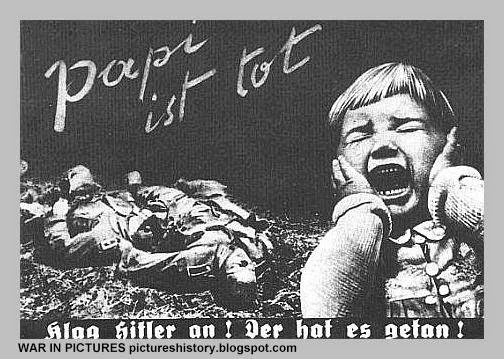
German Translation: Daddy is dead! complaint to Hitler! He is responsible! 
Comment: Telling children not to revolt against Hitler, because he is in charge 

German Translation: Adolf Hitlers youth got to an undenominational school
Commet: There is no religion they belong to, they all come as one. 

German Translation: National Socialism is the organized will of the nation
Comment: Nazism is the only way to go 

German Translation: Our last hope: Hitler
Comment: Their all relying on Hitler 

German Translation: We take the fate of the nation in the hands
Comment: Hitlers persuading citizens to give him their fate 

German Translation: In the dust with all are hostile 
Comment: Germany is powerful, we can smash the others into dust

German Translation: Workers, the end of the first selects the front soldiers 
Comment: They need the workers to produce the weapons for the front soldiers 
German Translation: Death of lies, Marxism high finance
Comment: Communism will bring you lies and death, 
German Translation: The enemy sees your light darken
Comment: This poster is for night raids, when the enemy would bomb the cities at night. 
The enemy will see your lights on, turn them off 
Dutch Translation (small red text) ^: The rescue of the European Culture on underway 
Comment: Sarcasm 


Wednesday, April 23, 2014

Imperialism

Imperialism- powerful nations controlling weaker nations

What? When? Where?
Develope a trading route in central Africa from upper and lower congo. Leopold captured the women and children to force the men to produce ivory and rubber.
Belgian took over Congo during November 15, 1908, and Congo gained independence in June 30, 1960.
 Why? How?
King Leopold enslaved the men to produce rubber so it can be used in automotive. Belgian also had more advanced guns, from the Industrial revolution. Which cause Belgian to take over Congo

Monday, March 31, 2014

William Tyndale

William Tyndale was born in Gloucestershire England, and was born between 1484-1496 and died in 1536. He was well known for translating the bible into English, He was influenced by Martin Luther and Desiderius Erasmus. In 1535 William was arrested for heresy. Then was later executed by getting strangled, after his body was burned to the stake. A couple years later Tyndales bible was used in the Church for Europe.


Wednesday, March 26, 2014

Renaissance Vocabulary


Secular is not living by the church.


Florence is a major city state northern of Italy.


Medici is the family that controlled Florence.


Frescos are paintings done with wet plaster and water based paint.


Raphael is well known artist for his frescos.


Donatello is known for Greek and Roman statues.


Martin Luther is known for protesting agains the Roman Catholic Church.


Indulgence is a fee to pay to get into heaven quickly.


Lutheranism is Martin Luther's religion he started.


Ulrich Zwingli is a priest in Zurich, whom began religious reformations.

Wednesday, March 5, 2014

Aztec Maquahuitl

What was the Maquahuitl? It is a war club that is 3-4in wide 3-4ft long piece of oak with obsidian embedded in the edges.

Who used the Maquahuitl? The Aztec Warriors used it in battle. 

When was it used? During the 16th century in the Spanish Conquest of the Aztec Empire. 

Where was the Maquahuitl used? It was found in Central Mexico. 

Why did the make it like this? They couldn't thrust it, so they used a different style of warfare  

How was it used? Could be used with either one had or two, used for close combat fighting.


Tuesday, February 18, 2014

Rise of the Mongols

                                                                                                                   Geography 
     The Mongols way of living was an advantage compared to the places they conquered. The Mongols are nomadic, therefore they can adapt to any terrain and weather. The Steppe gave them horses, they started riding horses and shooting arrows at age 3. Every year the steppe hosts the Naadam Festival. The festival consisted of Mongolian wrestling, horse back riding and archery. The steppe had many tribes, occasionally the tribes would go against each other, trying to show superiority. By having the multiple tribes compete against each other, it would help get each tribe stronger.

Leadership
Genghis Khan's leadership was different compared to the traditional Steppe ways, it was based on merit rather than the social class they came from. Genghis would also promote his best soldiers to generals. He would award his best soldiers with the most beautiful women they captured and the treasures they stole. Genghis Khan was really into loyalty, if a soldier disobeys or disrespects his general, the soldier is to be punished in a ruthless way. The way Genghis fought would be based on the art of war. Attacking when they least expect it and using secret spies to scout out the enemy. These strategies helped the Mongols fight against armies that were larger than them.
Genghis Kahn & his generals
Technology
The Steppe had a great affect on their technology, giving them horses and archery skills at a young age.  They became very skilled with using their horses. The Mongols have many tactics that include shooting arrows from tactics and riding horses for miles. In some tactics they would allow the enemy to chase them for miles tiring them out, leading the enemy to a group or archers. The Mongols would avoid hand to hand combat, so they would try to kill as much men with their catapult, arrows and javelins. The weapons they would carry for hand to hand combat were axes, scimitars, and lances.

Monday, December 2, 2013

Middle Ages


4.1 - Analyze impacts of the collapse of the Western Roman Empire
  • 4: Student is able to compare/contrast the Byzantine Empire, Franks, Vikings, and/or Muslims
  • 3: Student is able to describe the Byzantine Empire, Franks, Vikings, and Muslims
  • 2: Student is able to describe 2-3  groups (Byzantine Empire, Franks, Vikings, Muslims)
  • 1: Student is able to identify the Byzantine Empire, Franks, Vikings, and/or Muslims
4.2 - Examine the Feudal System and Roman Catholic Church in medieval Europe
  • 4: Student is able to compare/contrast the roles and relationships within the "feudal system" and explain impacts of the Roman Catholic Church
  • 3: Student is able to compare/contrast social classes within the feudal system and explain an impact of the Roman Catholic Church
  • 2: Student is able to describe social classes within the feudal system or impacts of the Church
  • 1: Student is able to identify social classes of the feudal system or an impact of the Church
4.3 - Analyze causes and consequences of the Crusades
  • 4: Student is able to explain causes and consequences of the Crusades AND critique a person or group involved
  • 3: Student is able to explain causes and consequences of the Crusades
  • 2: Student is able to describe a cause and consequence of the Crusades
  • 1: Student is able to identify a cause and consequence of the Crusades
I think Im between a 0 and a 1. 

Personal learning goal: Learn more about the Roman Catholic church, 

Tuesday, November 19, 2013

Caligula

Background:

  • Born August 31 AD
  • Accompanied his parents on military campaign 
  • Concluded he was "mad"
  • Sexually attracted to children and animals

Non-Achievements:
  • Forgot to tell his army to invade Britain
  • Ordered his military to collect sea shells 
  • Murdered entire family to keep power
  • Finance Crisis
  • Falsely accusing individuals, fining and even killing them
  • Higher taxes on marriage and prostitution 
  • Auctioning lives of gladiators 
  • ruled from 37 to 41AD

Cause of death:
  • 24 January 41AD
  • died at age 28
  • Cassius and 2 military colleagues 
  • Caligula stabbed to death
  • Cassius murdered other surviving relatives 
  • Fourth wife stabbed
  • Baby daughter's skull smashed against the wall

Tuesday, November 12, 2013

Spartacus


  1. WHO was Spartacus? a slave for entertainment. 
  2. WHAT did he do? Lead the Great Revolt. 
  3. WHY did he do it? For freedom then power. 
  4. WHEN did it happen? 73-71BC
  5. WHERE did it happen? All over Italy
  6. HOW did it end? Spartacus dies in battle
  7. WAS HE A HERO OR A VILLAIN? Villain, because the whole war is his fault. 

Friday, November 8, 2013

When in Rome..

Do as Romans do.
What did they enjoy, do, or believe in?

Religion: Greeks Believed in MANY gods.

Zeus
Hera
Aphrodite
Eros
Hestia
Poseidon
Ares
Dionysius
Athena
Apollo
Hermes

Jupiter
Juno
Venus
Cupid
Vesta
Neptune
Mars
Bacchus
Minerva
Apollo
Mercury

Heavens and Earth
Females and Marriage
Love
Spirit of Love
House and Home
Sea
War
Party, Wine, and Bad Behavior
Wisdom
Medicine and Poetry
Messenger of the gods

Food: The people of Rome had different diets, obviously the poor people had different meals than the rich. Rich people mainly ate pork, beef, poultry, fowl, lams, and fish, while poor people mainly ate grains. The rich peoples dinners lasted for hours, while poor people maintained the traditional mealtime.

Slavery: The Greeks were very dependent on their slaves. Surprisingly the slaves we treated with respect, and maintained a healthy relationship with their owners. They even put on a festival for the slaves (Saturnalia). A celebration in which the slaves and owners would switch places for a day. Being a slave is also a bad thing, it was embarrassing, and inhumane. Occasionally some masters would sell them into prostiution.

Tuesday, November 5, 2013

The Punic Wars


  1. Who was Rome's enemy? Carthage
  2. Why did it start? Rome was threatened by Carthage. 
  3. Where and when did the wars take place? Sicily, 264BC - 146BC 
  4. How was geography a factor? Alps mountains
  5. What key events took place? Its a series of wars. 
  6. How was technology a factor? Carthage had better a navy
  7. What tactics or strategies were used? Trade and Wealth
  8. How did the end result impact both sides? Carthaginians are either killed of sold into slavery. 

Tuesday, October 29, 2013

Monarchy to Republic

A republic is a form of government in which affairs of state are a public matter.
Rome became a republic because the kings son raped a highly respected women from the patrician class. Therefore causing a huge affect to those who are close to Lucretia (high respected patrician), causing the people to expel the old ruling family, and electing Brutus and Collatinus to be the new consul. 

Monday, October 28, 2013

When, Where and How was Rome founded.

Rome was found in 753 BC April 21st in the present day city of Italy. Romulus the grandson of the War God, supposedly built the entire Rome empire. The populations grew when they took the poor and imprisoned people from other city states. Also the roman soldiers abducted women from other tribes, and impregnated their wives and daughter. The tribes were unhappy causing them to revolt against Rome. Sadly Rome was too powerful, the other tribes came together with Rome.

Friday, October 25, 2013

Geography of Rome

1. Why would Rome have been a good place to found a city? Because the Tiber River, it can send ships through to transport goods. Theres also no harsh winters therefore the crops could be grown almost year round. 

2. Why would the Italian Peninsula have been a good a place to start an empire? Because it would be easier to travel? 

Wednesday, October 23, 2013

Rome Pretest

Differentiate Roman Republic from Roman Empire
Explain past and present impacts of Roman culture
Analyze factors in collapse of Western Roman Empire
Personal learning goal: learn more about Roman government


  1. When, where and how was Rome founded? Rome?
  2. How was the government of the Roman Republic organized? Aristocracy? 
  3. When and how did the Republic turn into an Empire? 
  4. How was the government of the Empire organized? 
  5. When, where, why, and how did the Romans expand? Conquering other cities and taking their treasure.
  6. What are Rome's greatest architectural and technological developments? 
  7. What was important in Roman culture? 
  8. Who were important Roman leaders? 
  9. What caused the collapse of the Roman Empire? 
  10. How did Rome alter history? 
  11. How does Rome affect us today? 
  12. What lessons can be learned from Roman history? 


Tuesday, October 15, 2013

Primary Source Analysis: History of the Peloponnesian War

    Thucydides, the general of the war at the time created a source talking about the plague that occurred during the Peloponnesian war. He personally survived the plague. The plague began in Ethiopia and traveled to Africa and finally to Greece. He created the source to inform future doctors and scientist to notify the possibilities for the plague to start again. The plague was devastating, causing you to lose body parts and your mind. In conclusion, living in Athens would disastrous, because you aren't able to travel beyond the wall, and having to stay in a largely populated area with a traveling illness. 

"For the disease, which took first the head, began above and came down and passed through the whole body; and he that overcame the worst of it was yet marked with the loss of his extreme parts; for breaking out both at their privy members and at their fingers and toes, many with the loss of these escaped; there were also some that lost their eyes." 


Wednesday, October 9, 2013

Greco-Persian Wars


     The Greco Persian war began when the Ionians revolted against the Persian Empire in 499 BC. They were defeated by the Persian army, but King Darius decided to invade Greece in 490 BC. Athenian army defeats Persian at the battle of Marathon, causing the persians to retreat. 10 years later Persia chooses to attack once again. In Thermoplylae, The Greek and Spartan army is out numbered and they were defeated. Persians then conquer Athens and burn it to the ground. Greeks then led Persians to Salamis, defeating their navy. Persians flee to Plataea but Greek defeats Persian army, ending war.